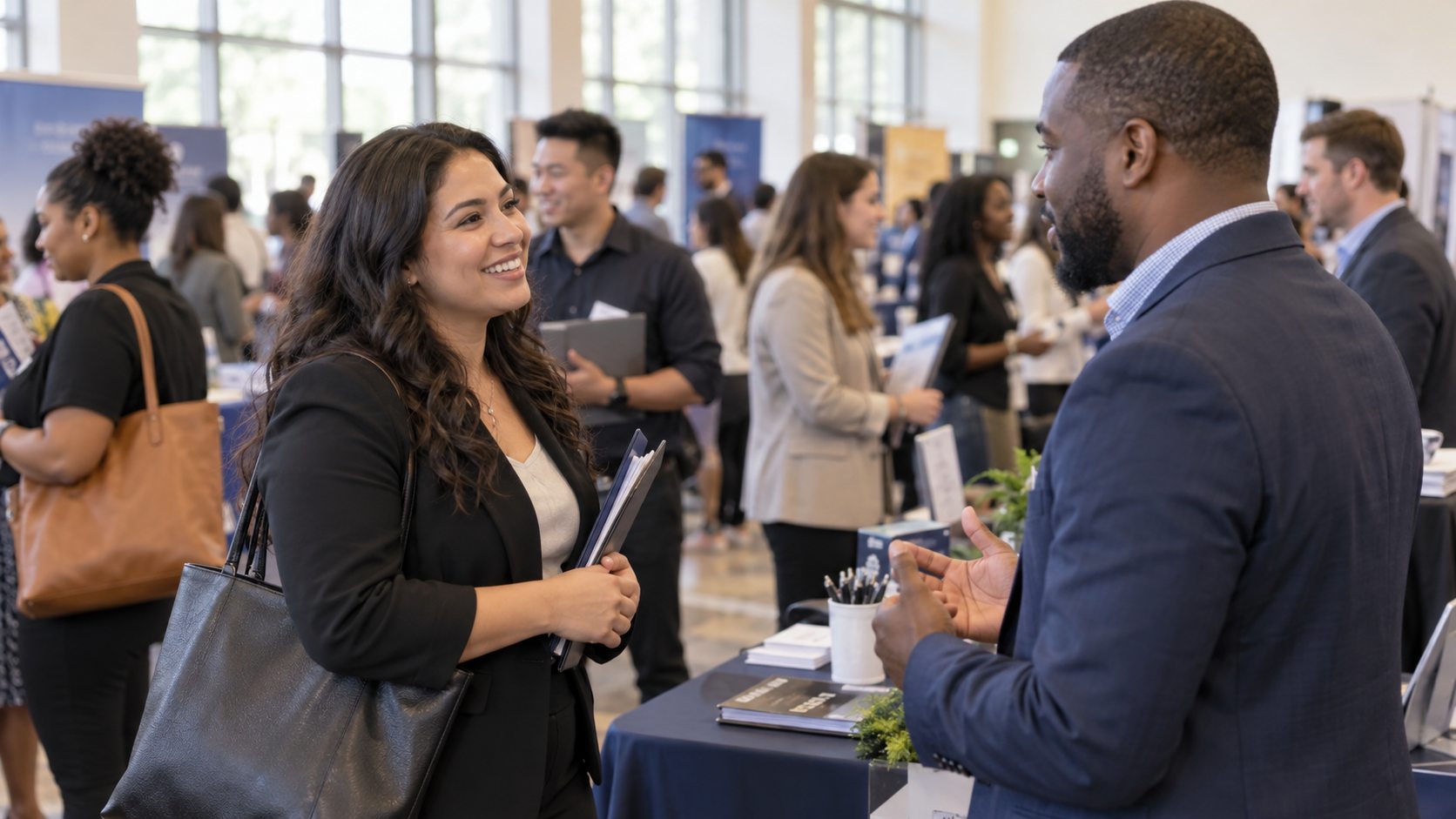
A job fair is most useful when you treat it as several short research conversations, not as a room where a résumé alone gets you hired. Choose a small number of employers with relevant openings, prepare a 30-second introduction tied to each role, ask one question that a posting cannot answer, and record what you learned before moving to the next booth.
CareerForce Minnesota recommends learning which employers will attend and preparing a brief introduction. The fair may be in person or virtual, open to the public or restricted to a school or industry. Read the event rules and employer list first. A crowded general fair can still be worthwhile, but the outcome may be a contact or application route rather than an interview offer.
Pick targets from real openings
Make three groups: high priority employers with a current role you fit; possible employers where you need more information; and optional booths to visit if time permits. For each priority employer, save the job title or requisition number, two requirements you can demonstrate, and one question about the work. Do not spend the whole evening researching every company. Five prepared conversations usually beat 25 generic greetings.
Bring a clear résumé if the event allows it, but also check whether employers require online applications. A recruiter may not accept paper copies. If you have different target roles, prepare a small number of truthful résumé versions with relevant evidence. Our résumé tailoring guide explains how to adapt emphasis without inventing qualifications.
Make an introduction that starts a conversation
Try: “I'm a customer support lead who has built reporting and training processes for a team of eight. I saw your operations coordinator opening and would like to understand how the role works with the support team.” It says who you are, what you can demonstrate, and why you came. If you have little formal experience, lead with a relevant project or task instead.
Do not recite your entire career or ask “What jobs do you have?” when the list is public. Ask about something specific: “What would the person in this role work on first?” “Which skills are hardest to see in an application?” or “Does your team hire for adjacent roles with similar tasks?” Give the recruiter room to answer and keep the line moving.
Manage the day realistically
Arrive early enough to find the layout and check in. Wear something clean and comfortable for the event; dress rules differ across industries. Carry water, a way to take notes, and a charged phone if the fair uses QR codes or online forms. For accessibility needs, contact the organizer beforehand about layout, seating, captions, or virtual access. You should be able to participate without pretending those needs do not exist.
If a priority booth has a long line, visit another target and return later. A 90-second exchange can be useful when the room is busy. After each conversation, write the person's name if offered, the role, application route, and one distinctive fact. Do not take a photo of someone's badge without asking.
Ask what happens next
Before leaving a useful conversation, ask, “What is the right next step for this opening?” The answer may be an application portal, a recruiter email, another event, or simply checking back later. Clarify whether they welcome a short follow-up. A business card is not a promise of an interview; a positive conversation is a lead to act on.
If the employer says to apply online, do it through the official route. Refer to the event only if it helps a recruiter place your conversation. Our application follow-up guide explains when a note is useful and when repeated messages add noise.
Follow up within a useful window
Within a day or two, send a brief note to contacts who invited it: “Thank you for explaining how the coordinator role supports launch week. I applied for posting 123 today and wanted to share the project example we discussed.” Do not attach a large packet or claim the person endorsed you. For others, make the application and track the date.
Review the fair as evidence: Which employers had roles matching your skills? Which repeated requirement do you need to develop or explain better? Which lead deserves a second conversation? Job fairs do not guarantee offers. A useful fair leaves you with clearer targets, a few legitimate next steps, and better information about the market than you had when you walked in.